








Košík
Váš košík je momentálne prázdny.
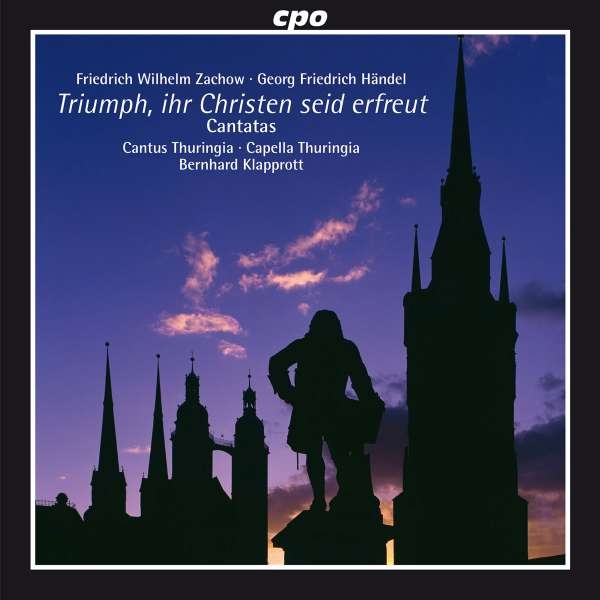
Zachow: Kantaten
10,00 €
Formát:
CD
Dostupnosť:
dodacia doba 7-28 dní
Katalógové číslo:
4987042
EAN kód:
761203764327
Autori:
Friedrich Wilhelm Zachow, Georg Friedrich Händel
Interpreti:
Capella Thuringia
Vydavateľ:
CPO
Zoznam skladieb
Ich bin die Auferstehung und das Leben (Kantate zum Osterfest)1
Chor: Ich bin die Auferstehung und das Leben
2
Arie: Gott lob, mein Jesus lebt
3
Arie: Gott lob, nun leb auch ich
4
Chor: Und wer da lebet und gläubet an mich
5
Arie: Gott lob, es hat nicht Not
6
Arie: Mein Glaube ist mein Schild
7
Chor: Weil Du vom Tod erstanden bist
Bei Gott ist mein Heil, meine Ehre (Kantate)
8
Sonata
9
Chor: Bei Gott ist mein Heil
10
Arie: Meine Hoffnung steht auf Gott
11
Arie: Meine Hoffnung steht auf Gott
12
Arie: Meine Hoffnung steht auf Gott
13
Arie: Meine Hoffnung steht auf Gott
14
Chor: Wer hofft auf Gott
Ach Herr, mich armen Sünder (Kantate)
15
Arie: Ach Herr, mich armen Sünder
16
Chor: Heil du mich, lieber Herre
17
Arie: Herr, tröst mir mein Gemüte
18
Duett: Ich bin vom Seufzen müde
19
Duett: Weicht, weicht, ihr Übeltäter
20
Chor: Ehr sei in's Himmels Throne
Triumph, ihr Christen seid erfreut (Kantate)
21
Chor: Triumph, ihr Christen seid erfreut
22
Arie: Weiber spart nur euren Mut
23
Chor: Heut triumphieret Gottes Sohn
24
Arie: Wer wälzet uns den großen Stein
25
Rezitativ: Erschreckt nur nicht
26
Arie: Wollt ihr Jesum aber sehen
27
Arie: Wir eilen und laufen den Heiland zu schauen
28
Rezitativ: Getrost, ich bin bei euch
29
Arie: Sünde, Teufel und der Tod
30
Chor: Triumph, ihr Christen seid erfreut
Popis
Friedrich Wilhelm Zachow succeeded the late Samuel Ebart as the organist at St. Mary's Church in Halle in 1684. This most important of Halle's musical posts included not only service as an organist but also the conducting of sacred music with the Halle town choir and the town musicians and the directorship of the town's chorus musicus. Zachow was active over a period of twenty-eight years and numbered among the most renowned church musicians of his epoch (J. S. Bach applied to succeed him in 1712), and his high art of cantata composition was famous throughout Central Germany. Just how much George Frideric Handel valued his teacher and his music is shown by his continued practice of citing compositions by Zachow in his own work even during his years in London. The authorship of the two cantatas presented here – often ascribed to Handel but whose author remains uncertain – has been discussed many times in musicology. One thing nevertheless remains clear: both works are from Zachow's musical circle of influence during the years just after 1700. Even if they turn out not to be by Handel, he surely would have known them and heard them. In this respect, this CD makes a significant contribution to our understanding of the young Handel's Halle environment. Prihlásenie
Newsletter


Copyright 2014-2026 © Hummel Music