








Košík
Váš košík je momentálne prázdny.
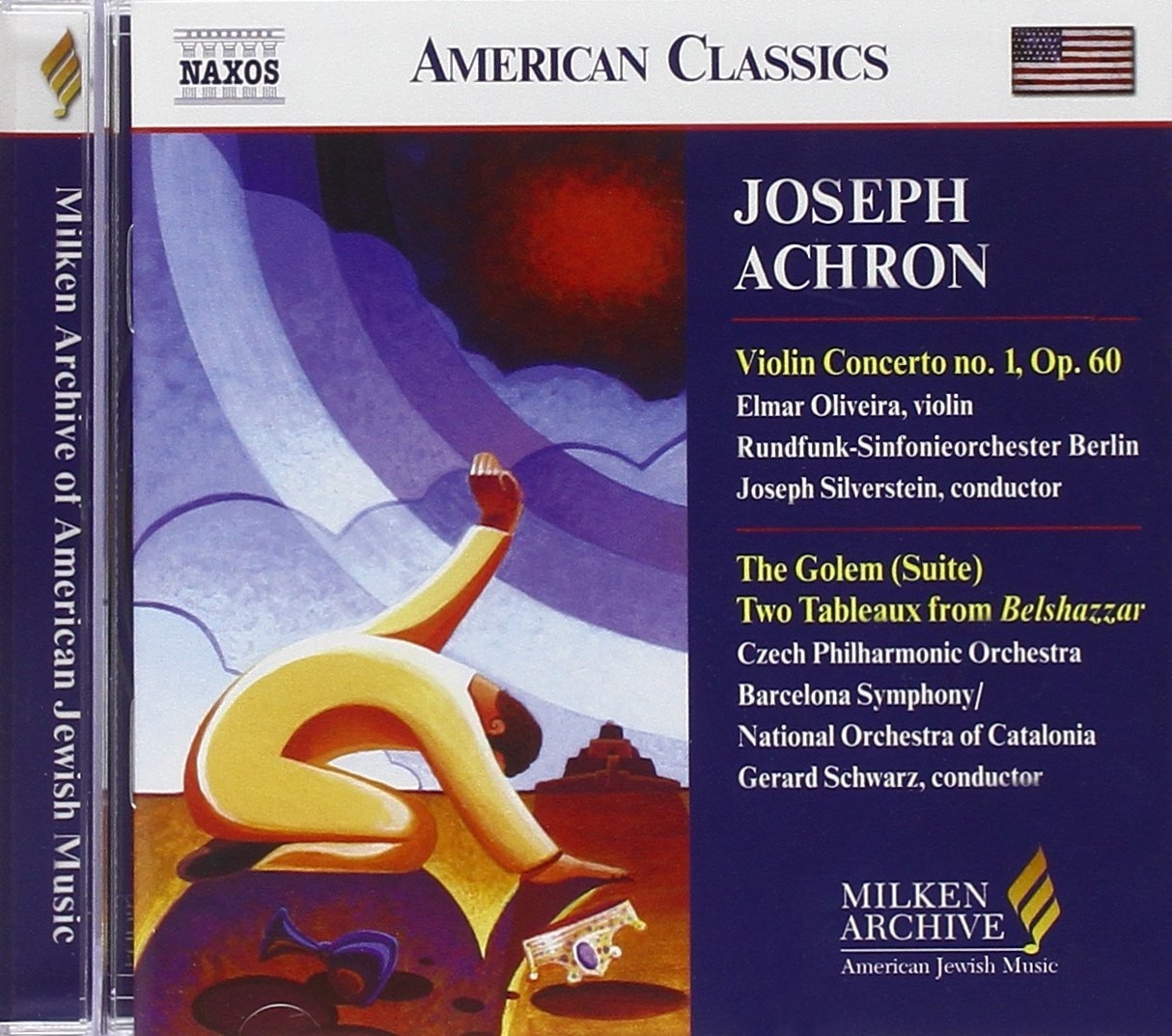
Achron: Violin Concerto/Golem Suite
10,00 €
Formát:
CD
Dostupnosť:
7-14 dní
Katalógové číslo:
8.559408
EAN kód:
0636943940822
Autori:
Joseph Achron
Interpreti:
Barcelona Symphony Orchestra, Czech Philharmonic Orchestra, Elmar Oliveira, Rundfunk-Sinfonieorchester Berlin
Vydavateľ:
NAXOS, NAXOS American Classics, NAXOS Milken Archive
Zoznam skladieb
Achron, J:Violin Concerto No. 1, Op. 60
Elmar Oliveira (violin)
Rundfunk-Sinfonieorchester Berlin
The Golem (Suite)
Czech Philharmonic Orchestra
Two Tableaux from the Theatre Music to Belshazzar
Barcelona Symphony, National Orchestra of Catalonia
Popis
Born in Lithuania and trained in St. Petersburg and Berlin, Joseph Achron (1886-1943) began his career as a violin prodigy, later also turning to composition. He became a leading member of the Russian Society for Jewish Folk Music but rejected the idea of a superimposed "Jewish style," striving instead to incorporate authentic traits of ancient Hebrew music, such as modal motifs and "cantillation" based on the chanting of Holy Scripture. The three works, recorded here for the first time, clearly demonstrate this. The Violin Concerto was written in 1927, shortly after Achron immigrated to America, and is dedicated to Jascha Heifetz (for whom Achron's brother Isidore worked as accompanist for some time). The first movement uses 15 "cantillation" motifs, mostly connected to the Book of Lamentations, which are combined and developed, giving it an episodic and pervasively mournful cast. The second movement, called "Improvisation" but fully written out, is based on two vivacious, optimistic Yemenite folksongs. Achron himself premiered it with the Boston Symphony under Koussevitzky. He must have been a formidable violinist: the solo part is extremely difficult, bristling with fast, often stratospheric passagework, double stops, chords, harmonics, and bravura cadenzas. The violin sighs, laments, sings, speaks, and dances. Elmar Oliveira plays it beautifully, with great virtuosity and a remarkably natural feeling for the style's irregular, chant-related accents, swiftly changing moods and emotional intensity. The orchestration is brilliantly colorful, strong on bass instruments, brass and percussion, as is the Suite Achron extracted from his incidental music to "The Golem," a play based on the ancient legend of the mysterious homunculus who must finally be destroyed. Basically tonal and conventional, its five movements feature a somber chorale (the Golem's creation), a wild march, a mournful lullaby, a spooky dance, and a return of the beginning in retrograde (the Golem's destruction). The two "Tableaux" are also re-worked from music for a play: the biblical story of Belshazzar's Feast. The first is calm, dignified, with a long violin solo, eerie flutes, strong basses; the second is a wild bacchanalia, with trilling flutes, booming basses, obsessively repeated figures, ebbing and rising dynamics culminating in a terrifying crash. --Edith EislerPrihlásenie
Newsletter


Copyright 2014-2026 © Hummel Music