









Košík
Váš košík je momentálne prázdny.
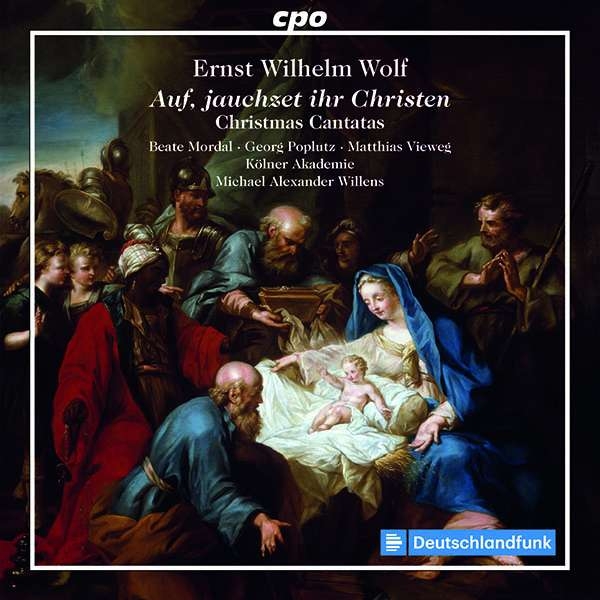
Wolf: Christmas Cantatas
10,00 €
Formát:
CD
Dostupnosť:
7-14 dní
Katalógové číslo:
555 524-2
EAN kód:
761203552429
Autori:
Ernst Wilhelm Wolf
Interpreti:
Beate Mordal, Die Kölner Akademie, Georg Poplutz, Matthias Vieweg, Michael Alexander Willens
Vydavateľ:
CPO
Zoznam skladieb
Willkommen, du sehnlich erbetener Tag1 I. Willkommen, du sehnlich erbetener Tag
2 II. Annehmlichste Verkündigung
3 III. Vergebens droht der Fürst der Höllen
4 IV. Ach, Hüter unseres Lebens!
Seid böse, ihr Völker
5 I. Seid böse, ihr Völker
6 II. Immanuel, mit uns ist Gott
7 III. Du, Held aus Jakobs edlem Samen
8 IV. Erregt durch Dank und Demut euren Geist
9 V. Er kann und will euch lassen nicht
Auf, jauchzet, ihr Christen
10 I. Willkommen, du sehnlich erbetener Tag
11 II. Annehmlichste Verkündigung
12 III. Vergebens droht der Fürst der Höllen
13 IV. Ach, Hüter unseres Lebens!
Willkommen, du schönster der Tage
14 I. Willkommen, du schönster der Tage
15 II. Umkränzt mit Sternen
16 III. Willkommen, du schönster der Tage
17 IV. Dir, Gottes ew'gen Sohn
18 V. So labt ein dürstend Land der milde Tau
19 VI. Erwache nun, Natur, und singe
20 VII. Zephyretten, lasst mit sanftem Wallen
21 VIII. Gelobet seist du, Jesu Christ
22 IX. Dort in der Krippen liegt das Kind
23 X. Retter der sünd'gen Menschen
24 XI. Enthüllt ist das Geheimnis!
25 XII. Falle vom Himmel nieder
26 XIII. Erfüllt, ihr schönen Triebe der Lieb' und Gegenliebe
Popis
In the 18th century, "well-stocked" church music was a natural tradition throughout central Germany: church services were embellished along the ecclesiastical year with cantatas appropriate to the liturgy for the glory of God, but also for the joy and "spiritual edification" of the visitors. From this treasure of hitherto unknown Christmas music, four cantatas by Ernst Wilhelm Wolf are presented for the first time on this recording. Wolf worked as court kapellmeister in Weimar, and the fact that Goethe rejected him as "self-indulgent" should not prevent us from admiring him as a very important composer of the transition. Musically, Wolf was greatly influenced by Carl Philipp Emanuel Bach in the empfindsamer Stil and by the works of the Berlin Kapellmeister Carl Heinrich Graun. He was also a prolific composer whose works were received with admiration by his contemporaries. The four cantatas show elements of the early classical and sensitive styles; the cantata choruses are often homophonic and songlike, polyphonic sections rather rare. All the cantatas prove to be individually conceived works that testify to the composer's mastery. Beautiful sounding arias, the naturalness of their expression and the dramatic compression in the individual movements are still convincing today. At the same time, the cantatas bear witness to the high quality of Protestant church music in the period after Johann Sebastian Bach and illustrate the high value of music within the liturgy. Today they can be a welcome addition to the repertoire for the Christmas season.Prihlásenie
Newsletter


Copyright 2014-2026 © Hummel Music