








Košík
Váš košík je momentálne prázdny.
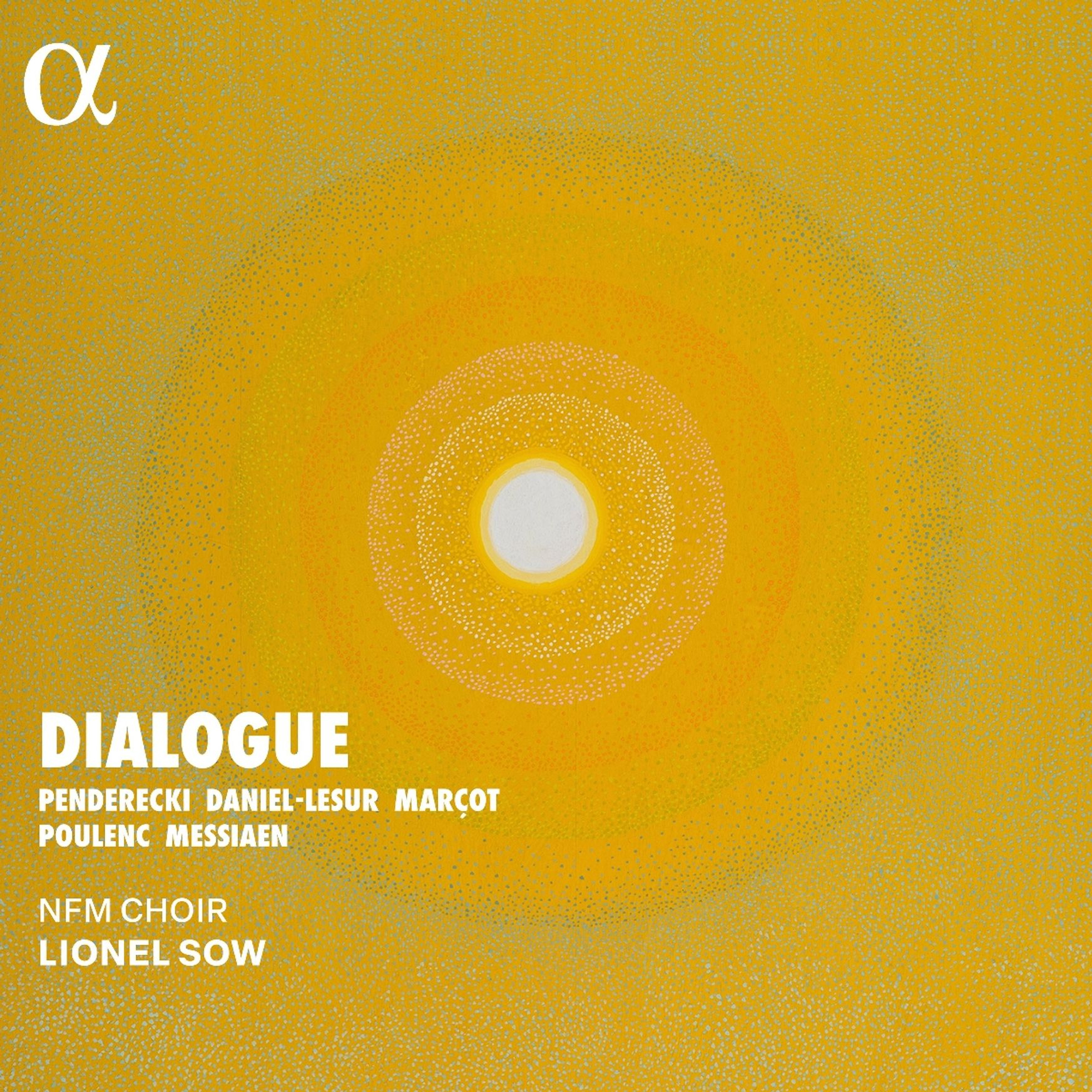
Dialogue (Penderecki / Daniel-Lesur / Marçot / Poulenc / Messiaen)
16,00 €
Formát:
CD
Dostupnosť:
7-14 dní
Katalógové číslo:
ALPHA1233
EAN kód:
3701624512333
Autori:
Caroline Marçot, Jean Yves Daniel-Lesur, Krzysztof Penderecki, Olivier Messiaen, POULENC Francis
Interpreti:
Lionel Sow, NFM Choir Wrocław
Vydavateľ:
ALPHA
Zoznam skladieb
Dátum vydania: 1. 5. 20261 Krzysztof Penderecki: Pieśń Cherubinów 7:07
Jean-Yves Daniel-Lesur: Le Cantique des cantiques
2 I. Dialogue 3:11
3 II. La voix du bien-aimé 3:11
4 III. Le songe 1:37
5 IV. Le roi Salomon 1:36
6 V. Le jardin clos 4:13
7 VI. La Sulamite 3:43
8 VII. Épithalame 2:58
9 Krzysztof Penderecki: Stabat Mater 8:41
10 Caroline Marçot: Nigra sum 4:43
11 Krzysztof Penderecki: O gloriosa virginum 4:18
12 Francis Poulenc: Salve Regina, FP 110 4:56
13 Krzysztof Penderecki: Agnus Dei 7:48
14 Olivier Messiaen: O sacrum convivium! 5:33
Popis
The NFM choir from Wrocław juxtaposes Penderecki and French composers, creating a dialogue between Polish and French music of the 20th century, between the singers from Wrocław, where the choir is based, and Frenchman Lionel Sow, its conductor since 2021. The program opens with Krzysztof Penderecki's Le Chant des chérubins, a piece composed in 1986 based on a text from the Orthodox liturgy. This is followed by a composition by French composer Yves Daniel-Lesur, a twelve-part Cantique des Cantiques composed in 1953. In 1962, Penderecki completed a Stabat Mater of a purely religious nature, a declaration of opposition to the communist system and its visceral atheism, but also to Western avant-garde circles, which were equally uninterested in the sacred. Fast forward to the 2000s with Nigra sum by composer and mezzo-soprano Caroline Marçot, who is very interested in Renaissance music. If there is one thing that Poulenc's Salve Regina, composed in 1941, and Penderecki's Agnus Dei, written forty years later, have in common, it is simplicity and a form of contemplation that can also be found in Olivier Messiaen's O sacrum convivium, composed in 1937.Prihlásenie
Newsletter


Copyright 2014-2026 © Hummel Music